The moment in many puzzle games that doesn't have a very good word in fact even the URL for this article is not very good
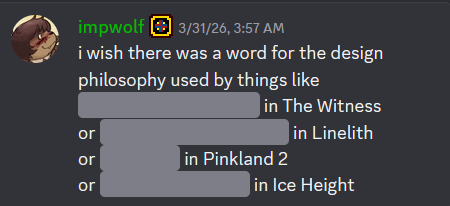
impwolf the absolutely prolific inventor of the highest number of Lingo-custom-maps (which are also very much quality) has this question:
What makes it more awkward is that the main game that could be said to represent the genre, The Witness, already sparked a different larger trend in puzzle games of "witnesslikes", which is less spoilery to describe:
- To not have tutorials using words
- A variety of 'symbols' which add restrictions to puzzles ('nonverbal communication', 'rule discovery')
- Subtle environmental aspects like shadows mattering, or the aesthetic of a 'ruined broken puzzle' to make the player visualize an effect
- Open world
So Lingo is a 'witnesslike' because despite being a word game, its tutorials are not primarily with words.
All that is to say, the word 'witnesslike' has already been spent. So now that that's out of the way, let's get back to the image:
i wish there was a word for the design philosophy used by things like
environmental puzzles in The Witness
or negative space in Linelith
or Whiteland in Pinkland 2
or backup everything in Ice Height
This is a moment in the games that is intended to be special, and therefore spoilery to talk about. I will not mention any spoiler directly, this article expects that if you're reading the spoilered section you already know about the game.
What is the name for this genre? (Spoiler: The Witness)
Environmental puzzles in The Witness
The specific feel of the environmental puzzles in The Witness are:
- It is a huge positive surprise to discover them.
- They permanently change how you 'look at' the world and what is considered relevant.
- They feel like they are just an extrapolation of a rule (or just another application of the "game's language") you've already been using earlier in the game.
- The game has the courage to hide it in plain sight, you can interact with this rule or find evidence of the secret way earlier than you will likely discover it.
My first thought was "hidden in plain sight". I asked Patrick, who made Linelith, who thought of calling them "baked-in" puzzles or like, 'the whole game is built around these secrets' things. These don't really roll off the tongue as a genre though?!
Anyway, here are some games that are in this genre:
This also has some overlap with 'troll puzzles', another genre I enjoy, but The Witness feels a lot more pure than a troll puzzle. The reason is that a troll puzzle might incidentally have 100 small things to analyze that end up being red herrings, but "the game has had this in sight for five hours and you now see it in a new light" is very different, it's no longer at risk of being a 'one cheap trick pony'.
Despite that, you can watch any of my 'troll puzzle' video playlists or play some games with some troll moments, but there is no Big Moment that lasts the whole game with these (instead the troll is in individual levels):
It's a bit weird, come to think of it, I think you could make an argument either way of if these "troll puzzle" games are necessarily 'worse' at having these surprise moments than ones that set up big reveals. The best of both worlds is probably in Linelith's category where it (vaguely) feels like multiple big moments that all fit one theme.
Spoiler: Taiji
Because Taiji was likely to be played by fans of The Witness, if there were directly interactible environmental puzzles it would not be cool. Unfortunately, this is another moment where originality is spent (you could very much imagine the universe where if Taiji existed but The Witness did not, you could have directly interactible puzzles for a similar special moment). However, what this game does is use suspicious bits of the environment as info for metapuzzles later, and disguises it somewhat often, which is still a very cool execution.
Spoiler: Linelith

This game basically repeats a rule that is more general than you thought, and I love how despite it being general, it feels like it's 'waves' of realization about what counts as part of the rule. Because the rocks being the player and walls and floor and space all have such different connotations.
Hey when is that game going to get the fan suggestion DLC where the bottom left bar should totally have been a final puzzle
Spoiler: Ice Height
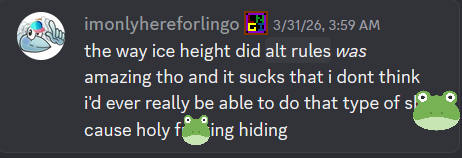

As I have already talked about this game in 2.5 hours of walkthrough and commentary, I don't know if I have that much else to say in this article, except that the:
They feel like they are just an extrapolation of a rule (or just another application of the "game's language") you've already been using earlier in the game.
is not quite true in Ice Height, but foreshadowing multiple "key phrases" and suspicious things makes it so much more thematically fair, which is actually a thing I've seen in many mystery novels! In fact I also feel that mystery novels and games have a similar feeling, but purely in-story, where something deep and important has had its effects in play the whole time, but you did not notice or realize, which also adds some replay value. Once again though, things like 'the curtains were blue' or 'my stomach grumbled' could be completely mundane and meaningless, OR it could be super foreshadowing, and it's sort of playing on that ambiguity, people can sense a bit of "unfairness" with that. Especially because supernatural rules can be in fiction, the "fairness" can be somewhat in question there too.
It can be less viscerally satisfying in mystery fiction also, because it very much requires you to think of events in a way where you've been constantly considering the edges and hints of the missing understanding. In a game you choose where to look with hints, in a mystery novel you cannot personally inspect the scene.
I wonder if it could possibly be considered related that metroidvanias and platformers have certain tricks and techniques that you may not understand, but then get more explicitly shown. That seems too core to the genre and not a large 'hint' surprise in the same way, it doesn't necessarily immediately make the world feel a lot more intentionally constructed and larger just because there was a secret way to use a dash.
It's hard to even maybe describe other games that have something similar, I'm only preemptively mentioning metroidvanias due to that reason. Outer Wilds' knowledge-based discoveries are smaller mechanical moments over a long period of time. Puzzlehunts have 'metas' that are far-reaching but potentially not mechanically revealing about some earlier puzzle.
Perhaps even naming the genre is some sort of "impossible spoiler", the kind of spoiler that even giving it a name to would point to the experience too obviously. The fact that Taiji was restricted by the fact that it was inspired by The Witness such that it couldn't quite do the same thing for people on the lookout for something like The Witness.
Comments and Appendix