Why is Lingo a lightning in a bottle?
The open-world word puzzle game Lingo is truly special and has become my favorite word game ever made.
I have a massive playlist of edited videos about it, and have made over a dozen custom maps on it.
I have sort of wondered if there is a specific thing that makes it so special, that other games could take inspiration from. Why are many other word games obviously a lot less inspired in their design space?
After all, Lingo itself has game design inspired by The Witness with nonverbal communication, and usage of 3D space for a game interface that seemingly could only take place in 2D. Much like The Witness, the 3D does actually have an important point - it allows the 3D-involving puzzles to not be obvious that they are using the world, and expands the possibility space even in puzzles that end up not using 3D, but that's not the whole story...
This article obviously will have spoilers, so either play the game or watch the playlist where I cover the early game.
There is also a great article "Adventures in Word Puzzles", by hatkirby, another early player/tester and modder of Lingo, that has this quote:
Lingo has a lot of tricks that help the player deduce the solution to a puzzle, outside of how the text on the panel is crafted. Many puzzles are hinted by nearby puzzles that share a theme or combine to a greater solution. There's also a set of words that the game is fond of that are repeated across multiple puzzles, which means that you can sometimes figure out a puzzle just because the solution word is salient from having seen it earlier on. This in itself is a form of "second hinting", as I've suddenly chosen to call it, and it's likely that I'll end up using it in some form in my randomizer.
These secretly repeated themes throughout the game are cool, but those still aren't the mechanics that make it special.
Creator quote
The creator of the game, Brenton, has said this about it (when discussing the design of Lingo 1 vs. Lingo 2):
The Lingo 1 mech structure was one of those once in a lifetime, lightning in a bottle, accidentally tripped over this thing idea. I can't do that again. I'm always trying to think up things that haven't been done before and I hope whatever Game 3 is, it has a similar kernel to it.
It is also interesting because, well, Lingo 2 has not quite had the same level of sheer innovation in modded content as Lingo 1. 'symbols' map to 'colors' and many ideas for mechanics have already been done in Lingo 1
Are the base rules extremely simple?
As you may be aware, your mentality of a game is way different before you play it, when you're just learning it, and when you finish it. In fiction 'characters' start as strangers, then you subconsciously buy-in to them, and they become familiar faces, could be said for all of life but also applies to mechanics.
There is something incredibly pure about using colors as a representation for mechanics, so it is very easy to get attached to.
Plus, thematic and literal repetition is also more visceral when descriptions for the mechanics become fundamental instead of arbitrary, especially as puzzles start to involve more elements.
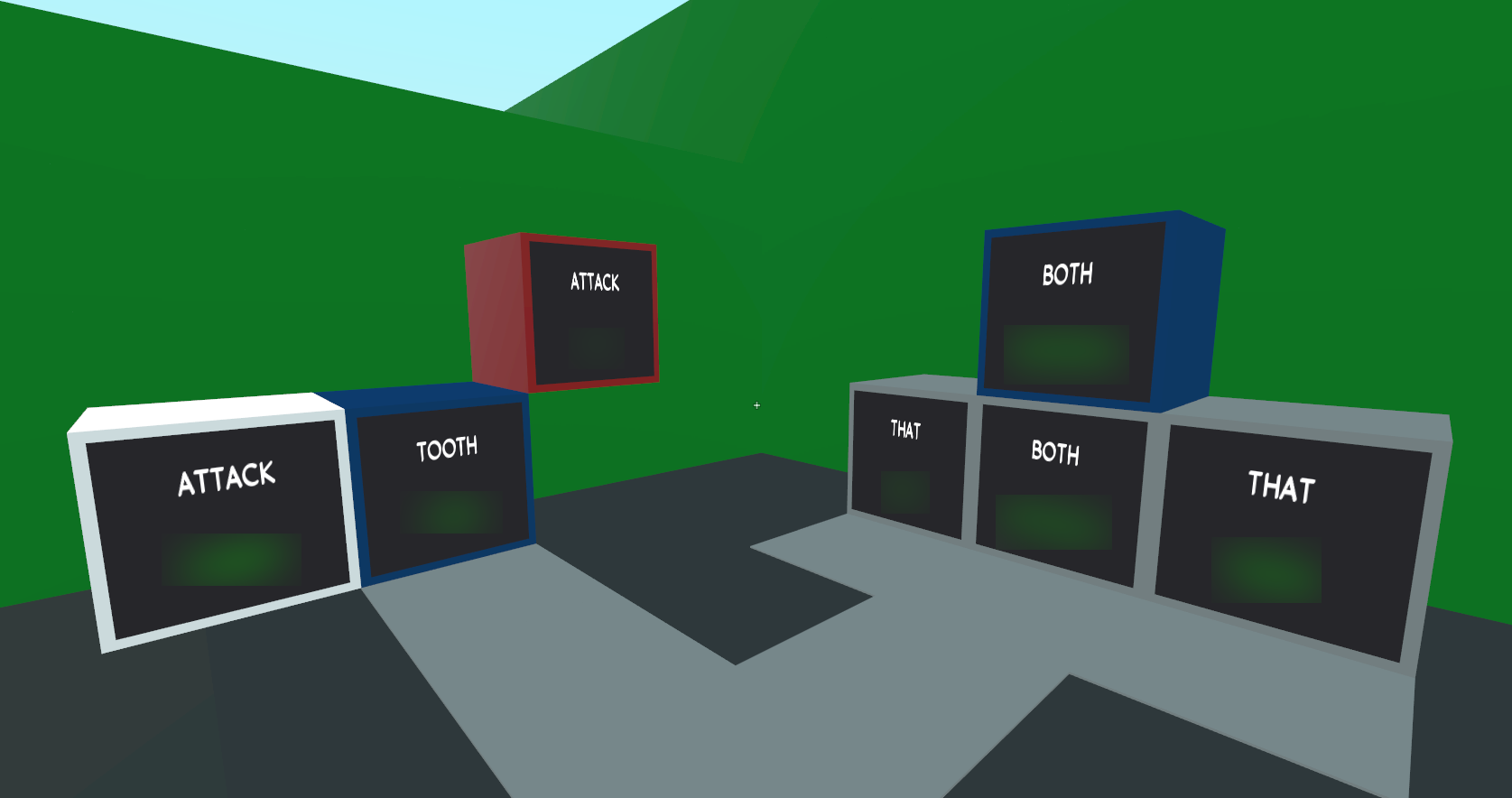
A literal description in a sentence of a more complicated Lingo puzzle would often be way way more complex to describe than the player who is ingame conceives the puzzle to be. Here is what it would be (spoilers!):
"Synonym of ATTACK, conceptual addition of TOOTH, letter-removal of ATTACK - the answer to two of those three puzzles put together make the answer to the third word. Some meta aspect of THAT (pointing to the 'TOOTH' block), (add letters to BOTH + some meta aspect to BOTH (pointing to the 'TOOTH' block) that share the same answer), some meta aspect of THAT (pointing to the 'TOOTH' block) - the answer to two of those three puzzles put together make the answer to the third word."
Does it create a system that fits many wordplay mechanics into a broader theme, which also expands your mind by extension?
Before I ever played Lingo, I was of course familiar with obvious wordplay-related concepts like 'anagram' and 'palindrome'. What was amazing and cohesive was managing to put all of these into a system that did not even require those terminologies to exist to make sense of, and that also deeply sparks the imagination due to having unused aspects that custom creators can build upon.
For example in this video I go over mechanics that seriously bring 'meta' and combination aspects that could fit in the maingame and feel like such natural extensions of the game's mechanics.
In a display of how 'complexity' is actually subjective and concerns audience expectations, Baba Is You also hugely leverages an English-speaking audience. Spelling 'a sentence' and having an effect is natural. Using text to refer to objects, then literally having the word TEXT appear is an incredibly meta thing. The well-known fan mod of Metatext can be recursive! The base game left so much untapped potential with words and what could target what (I have played years of new Baba mechanics and it still hasn't run out).
It's kind of odd to think that in both examples I make the point that the games leverage something fundamental about 'the real world', even though the English language is not actually fundamental, but might as well be. Mystery games like Ace Attorney and cross-examination/contradiction logic finding are broadly using the rules of real life so their design space is also infinite, and you could fit any story in an Ace Attorney-like format.
Maybe what's also special is that in both Baba and Lingo, the game mechanics allow you to draw some surprising connection between things that should be very far apart. In Baba "EMPTY", "MIMIC", and "MORE" are very mechanically distinct, yet just by being pushable text they fit in the same game. The wordplay in my Move Counter game is also something that is similar in the way of connecting faraway concepts. It could be a game jam style challenge to connect two seemingly utterly unrelated things like 'stairs' and 'curtains' and 'constellations' and you may get something interesting if you followed a chain between them.
Lingo 2 in some ways could have had a moment where symbols were revealed to be extensible and expandable like a conlang.
There have been some thoughts I've had for a long time, about making a language learning game, or math/periodic table memorization game, that's actually good. The problem is so many people have also tried to make language learning games, often with the problem of getting tacky educational vibes, or that the topic is actually just way too big to be useful to people who seriously want to learn it.
If you try to make a realistic periodic table learning game you suddenly have to try to make covalent bonds a game mechanic. Lingo: "Level Apple" involves learning Japanese through Lingo, but that doesn't scale you to 2000 kanji and everything. And also you likely wouldn't make that for $0, or $10, probably instead $10 a lesson or $10 a month for all the effort it'd require.
I hold hope one day that these games can exist though!
Comments and Appendix